Showing posts with label Retirement. Show all posts

1/25/2016

Jordan's Retirement Savings

We got some great news a few weeks ago.  Jordan's employer is increasing the amount that they will match for his RRSP.  I mean, the really great news is that he's actually working somewhere that has a retirement program!  It's the first time ever.

The company establishes contributions based on previous years profitability and the employee's salary.  I'm not sure what the actual formal is, but last year it was matching up to $24/pay and 2016 it's increasing to $42 and change a pay.  I like round numbers so we're going to contribute $50/pay to get the full match plus a few extra bucks of our own.

Yay, it's like free money
Granted he has to stay with this company for five years to keep all of the employer contributions, but that's still pretty awesome considering his industry doesn't often have retirement benefits of any sort.

It's not 10% of his salary - which would be nice, but it gets us halfway there.  If we can get another $200/month in savings for his retirement that would be ideal. Our ability to swing that will depend a lot on what we wind up doing for housing here in BC and what I wind up doing for work in a years time.

Time will tell.
9/22/2015

$10,000

Some of you know that the company I used to work for has an employee ownership model.  As part of that, I own shares worth $10,284.30 USD.  If the USD/CAD conversation rates stay about where they are now, the refund should wind up being closer to $13,500 CAD. I should note that it is not an option to maintain my shares if I'm not an employee.

As per my shareholder agreement, the company has up to six months from my departure to sell and issue a refund to me.  I've confirmed that I will receive the money in USD in a cheque.  So, sometime between now and the middle of February we'll get a cheque and need to have a plan for the money.

I've always considered the money invested in shares part of my retirement plan, but now that the funds are being paid back, I'm feeling a bit torn.  Jordan and I chatted about it over the weekend some and he's also a bit conflicted.

Here's the options that we're thinking on:

  • Keep the money fluid in my TSFA 
  • Pay off the Kia 
  • Pay off half off the LOC debt
  • Move the money to RRSP
Keeping the money fluid does have it's advantages.  Certainly it would fully fund our emergency fund and then some.  We don't know what type of job I'll find next year, so it might be good to have this as cash to remain flexible.  This also opens us up to spending the money even if we don't really need to.

Paying off the Kia is a super attractive option.  The interest rate is 0%, and as of today we owe just over $15,000 on it - so it would be so so close to being paid off with the share money.  We pay a little more than $250/month on the car and not having that payment would give us a different type of month-to-month flexibility.  That money could be redirected to paying off the LOC - going from $500/month to $750/month, or directed to savings that we've had to pull back on because of going on EI. Putting the money towards this debt has the advantage that it can't be 're-spent' unlike the LOC.

Paying a big chunk on the LOC would make tackling the rest of it feel actually achievable.  Since using it to build the garage and fence on our Alberta house, the balance has gone up and down from $19K to about $25K. Currently it's sitting at $23,500 - so the share money would get this down to a manageable $10,000.  The interest rate on the LOC is 5.73%, so from a financing charge perspective it makes more sense to lower this debt than the Kia as well.  The minimum payment would reduce by about half which would give us equal month-to-month flexibility that paying off the Kia would give us (reducing the required paying by about $250).

Last option would be to just move the money into RRSPs.  This wouldn't impact our cash flexibility in anyway, but would lock in the money to long term savings which was the original intent of it.

So, what do you think?  Keep the money as cash, pay off debt, or move the money to long term retirement savings.  We could really use your thoughts on this one.


8/12/2014

Power of Attorney

Do you have one?

Are you a representative on someone else's behalf?

Over the last few months I have been working with my great aunt and her lawyers to make some changes to her current POA over to me.  It's right around the corner now, so I thought I would share that with all of you....I'm not going to be renaming my blog, Jessie, Jordan, and Jessie's Great Aunts money - but I might have some new things to write about.

Some topics that I expect will come up will be managing other peoples money, financial planning in retirement, and even elder abuse.

Does anyone have any other topics they might find interesting around POA and the responsibilities or the risks involved?  Drop me a line to let me know!

5/13/2014

Investing - Asset Allocation

After writing about my pension asset mix a month or so ago, I felt like I hadn't really finished the exercise so I went to the front page of the internet and found a sub-reddit for personalfinancecanada and there I asked about pensions and asset allocation - and what I got, was a big lesson that I wanted to share with you.

First, if you haven't seen it before - I would really encourage you to check out the Canadian Couch Potato Blog.  It's written by Dan, and Dan's got a lot of credibility on the topic of investing in Canada.

no, this is not a sponsored post, I'm just excited about it.

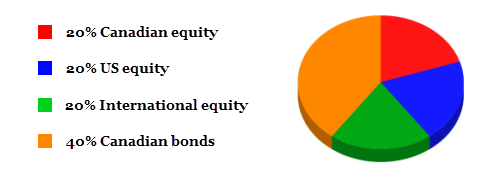
On his site, and through some help on reddit - I learned a bit about index funds and some recommended approaches for setting an investment mix.   One of the approaches, which appealed to me had a balance of bond and index funds - for the medium risk appetite.

I totally see now, why those that commented on my last post about the topic thought my investments didn't have enough equity built into the mix.  Someone on reddit suggested I
  1. Determine your preferred asset allocation (ie, above graph)
  2. In a spreadsheet, pool all of the values of your various accounts and parcel the total out into buckets representing the percentages from #1 to the various asset classes.
  3. Distribute the individual asset class values across the accounts based on tax efficiency. You match asset classes and accounts. A spreadsheet is really helpful for this.
So, I did just that...and here's what my current state of affairs looks like including all investments.


Then, I played.

I played and looked at my investments until I came up with the following 'future' state...which is what I'm thinking of doing.  Basically, it involves:
  • Changing my TSFA DISA to the Tangerine Balanced Income Fund
  • Adding the balance of my RRSP DISA to my RRSP Tangerine/Streetwise Equity Growth
  • Adjusting the asset mix of my pension (tossing Trimark has it had high MER without higher growth)


I wanted to put this back out to you before I actually made the changes.  What do you think?  Am i missing something?  Do you think the advise to go with the Canadian Couch Potato Asset Allocation (40-20-20-20) is a good one, or do I still have too much in bonds?


4/28/2014

What is most important?

A few weeks ago, Gail wrote how important it is for people to identify what is really and truly important to them.  She mentioned that Canadian's living on government assistance may have as little as $16,000/year or less to live on.  Well, I would like to share with you a real example of this - my grandmother.

Born in 1929, she grew up on a farm in Alberta before her and her family moved to beautiful British Columbia where they had their own homestead.

At 19 she married my grandfather, 10 years older than her who was just back from WW2.  He became a game/wildlife trapper and she a housewife.  They had two children together and raised them on the farm that her parents had started.

My grandfather passed away in 2001 at 81 years old - they were both still living at their homestead at that time, living on government assistance - that to be honest, I don't know if any of us really knew how much they had...but at least they both had it.

Now, my grandmother is 85 and dementia has been slowly taking it's grip of her.  She did not have an inheritance from her parents, her and my grandfather had perhaps a few thousand dollars saved away in the bank.  My grandmother had never worked outside the home, never contributed to CPP...she never even had a driver's license (not for a lack of driving). So, she has government assistance....but what is that, how much does she get as an elderly person in BC?

Old Age Security (OAS) provides $6,579/annually
Canada Pension Plan (CPP Survivor Benefit) provides $2,823 annually
Guaranteed Income Supplement provides $7,378 annually

The grand total comes to $16,781, hit Gail's number right on the mark...so what can she afford with that?  How much does it cost to live now?

Well, my grandmother lives in a assisted living home in BC. The rates are regulated by the province, and there are no other choices if we want her to be close to home - they are the only option in my small home town.

Here's a bit of a summary - after rent, medical care and clothing (she starting to need adaptive wear, so she's buying one or two new pieces a month) - she's got about $100 left a month.

You don't see a phone here, cable, gifts, emergencies, entertainment..no books....you see the bare bone basics to live.  You also don't see much flexibility for saving - which she does, we bank whatever's left over for her so that when she does need something extra - and not extra in the way we might think of it - she can afford it.  The last 'extra' for example, was a $915 wheelchair cushion.

And what if she didn't have dementia...it would be no different; other than she would know that she was missing out on buying gifts at Christmas for her children, grand-children, great-grand children...that she would know it takes a year to save for a new part for her wheelchair.  There are no outings, no extras, no treats.

My grandmother is my inspiration to work hard, save hard.  To drive myself in my career so that I can live a good life now without sacrificing my life tomorrow.

1/10/2014

ING Streetwise = Success

Back in July, I shared that Jordan and I were going to try out ING Streetwise accounts to see if it was a good investment fit for us...I'm so very pleased to share that it has been an overwhelming success!

We both chose the Streetwise Equity Growth Fund and it's been amazing!

Book Value Market Value Increase
Jessie  $  3,236.59  $     3,655.74 12.95%
Jordan  $  4,662.39  $     5,271.16 13.06%


In just 6 short months - the funds have already increased by $1,027.92...talk about a way to increase your networth!
 
P.S.
If you are planning on switching to ING Direct, consider using my Orange Key.  If you deposit $100 or more, we'll both get a bonus $25!

11/01/2013

$7,900 in Teeth

Jordan was born with two congenitally missing teeth - every since he was small; his benefits have only provided for a flipper/mouth piece that give the appearance of teeth.  That appliance after 20+ years is now starting to wear on his existing healthy teeth causing more problems.

So...given that for the past year we have been exploring alternatives to the mouth piece.  There are two - either bridge or surgical implants.  For a variety of reasons; primarily longevity, quality and ease of maintenance Jordan has chosen implants.

After many quotes, and many arguments with our benefit providers and dental surgeon...we have a plan.  The total cost of the two implants is $7,900 - are combined benefits will reimburse us $3,000 each calendar year....that led us to the tough decision to plan for two surgeries rather then one.

Jordan's already undergone the first surgery to implant a screw into his jaw bone and now we wait 2-3 months for it to heal. Once healed (end of December), the implant/screw will be fitted with a tooth.  Then, and only then - when the first tooth is considered 'complete' can the dentist submit the expenses to our benefit providers.  So, Jordan and I have had to pay cash (read use the credit card) for the first part of the procedure (and will continue to pay cash each time something happens related to the procedure).  In January we should get our first reimbursement; and then we'll promptly schedule the second surgery.  

Our debt load is getting a bit scary, but we have a plan and will eventually be reimbursed.  Jordan and I would both rather pay the interest now for him to have a happy and healthy mouth before we have kids or anything else when there are more demands for the money.

8/29/2013

CPP & EI - I hit my max!

Woohoo!  I finally hit my CPP and EI contribution maximums.

Now that I've hit my max, my take home pay will increase by $180.56/pay.  For the remainder of the year that's $1,444.48.  I knew this was coming a while ago, and so this extra cash is already allocated toward paying off our backyard project - but it still feels so good when it happens.

For those folks that follow my blog that live outside of Canada, I've put a little blurb below to explain what these two programs are.  

Canada Pension Plan (CPP) 
The Government of Canada established the CPP program in 1966. It is an earnings related social insurance program that provides basic benefits when a contributor to the plan retires or becomes disabled. When contributors die, the Plan provides benefits to their survivors. The benefit is meant to supplement an individuals personal savings, investments and retirement portfolio. The employer is required to contribute the same amount of CPP that is deducted from an employees pay to a maximum amount every year. A CPP retirement pension is a monthly benefit paid to people who have contributed to the Canada Pension Plan. The pension is designed to replace about 25% of a person's earnings from employment. Every employer is required to deduct CPP contributions from an employee's pay if that employee meets certain requirements (age, is in pensionable employment, is not currently receiving CPP benefit through retirement) to the annual maximum, which can change from year to year.

Employment Insurance (EI)
Employment Insurance provides temporary financial assistance for unemployed Canadians while they look for work or upgrade their skills.Typically, you will not be approved to receive an EI benefit if you quit or are fired your job with cause. If you are laid off, this benefit is available for you to apply for. Canadians who are sick, pregnant or caring for a newborn or adopted child, as well as those who must care for a family member who is seriously ill with a significant risk of death, may also be assisted by Employment Insurance. Every employer is required to deduct EI premiums from their employees insurable earnings on every dollar up to the yearly maximum. All employers must also contribute 1.4 times the EI premium withheld for each employee.

7/11/2013

Are we saving enough for retirement?

This is certainly not the first time I've asked this question, nor will it be the last.  I got to thinking about it after writing the post the other day which included an update that Jordan is contributing an additional $25/week to his RRSP Streetwise Fund with ING.

I'm lucky that I have a great company sponsored pension plan at work.  It's a defined contribution plan, which means what I get out of it really depends on the market but there is a set amount that both I and my employer contribute (5% of my gross salary each).  My rate of return based on my chosen investment mix was 4.9% two years ago and 9.9% last year.  Year to date, it's 4.2%.  Jordan, is not so lucky.

Here's a breakdown of our current annual retirement savings:

The RISA is the basic RRSP with ING, Streetwise is our investment RRSP account with ING.  Shares I purchase through my employer but are not a registered retirement plan - I consider this to be ours, not mine or Jordan's.  Finally Jordan gets a small annual profit share that is automatically contributed to a work RRSP account.

We are looking at a lump sum share purchase that would increase this years retirement savings by about $6,750 - but I really want to focus on the annual contributions, not the random lump sum stuff that we do.

So...what do you think?  Is it enough?

I would like to see us increase Jordan's savings by at least $15/week - but that's really only to meet the arbitrary 10%.  

7/09/2013

Recent Decision Making

The last little while, my posts have been a bit all over the place as we've had some conflicting priorities.  I've talked about buying an investment property, or investing in RRSPs or even investing with shares at work.  I've talked about paying off the escape and looked at increasing our mortgage payment.

There are just so many options.

Yesterday I wrote about our decision on a vehicle - basically, we've committed to continuing to do research and not rushing it.

We have also decided to buy more shares at my work which is an investment in both my career and our retirement.  We have also moved our RRSPs with ING from a RISA that was getting 1.35% to a Streetwise Mutual Fund Portfolio.  Specifically, the Equity Growth.  It's high risk/high return - but it's a relative low sum of money (under $6K combined), and we have 35 years of investment time.  The portfolio is trending very strong at 8.73% YTD.  While we will continue to contribute $50/week (each) to our RISAs, Jordan is now also contributing an additional $25/week to his Streetwise! So pumped!

We haven't written off the idea of an investment property, but we have put it on hold for at least a year or two.  We want to focus on our family and a few other things before we go down that path.

1/09/2013

This Christmas

This Christmas was hard.

It was the first without my dad.  It was also the first without my brother (he's moved to Winnipeg).  It was Jordan's first without his mom and his brother (they were on a trip together).

I tried to stay upbeat and positive, mostly I faked it until I could make it.  I think for the most part people believed that I was in good spirits, and that put me in a better mood then I would have been otherwise.

I had a lot of lists.. I always do, but this year it felt a bit more mechanical.  That helped get through I think...task lists...accomplishing things.

To distract myself, I made a lot of Christmas gifts this year.  We also spent a lot - but instead of telling you how much we spent (I don't 100% know just yet... haven't added up all the receipts), I would like to share with you some photo's of my creations...

Homemade Chocolates


Hand Painted Christmas Bear


Home Made Spice Blends

Stocking Stuffer for Jordan

Scarf for Jordan's Cousin
Scarf for my Mom
Scarf for My Cousin 

5/25/2011

Centerpieces & Isle Flowers

This past long weekend I went to my parents place in BC to spend some time with my mom putting together the centerpieces and ceremony isle planter pots.  Other than getting a nasty sunburn, it went really well and was low cost too!

We had gathered the centerpiece pots and painted them a while back and had some excellent soil that we had been given a while ago which was fantastic.  My mom graciously bought some miracle grow as well as the flowers (approx $175) and we had bought some large planter pots from Walmart (approx $30) as well.

All told the total cost was just over $200 for our centerpieces (25) and isle flowers (12).

Here's some photo's of pulling everything together:


12/07/2010

Changes to the Canada Pension Plan

I came accross an article in The Globe and Mail who published on October 28, 2010,  that discusses upcoming changes to the Canada Pension Plan (CPP). I hadn't heard of any changes, so I started digging.  Before I share what I've learned, for my non-Canadian readers, The Government of Canada established the CPP program in 1966.

It is an earnings related social insurance program that provides basic benefits when a contributor to the plan (someone who is employed in Canada) retires or becomes disabled. When contributors die, the Plan provides benefits to their survivors. A CPP retirement pension is a monthly benefit paid to people who have contributed to the Canada Pension Plan. The pension is designed to replace about 25% of a person's earnings from employment, up to a maximum amount.

Commencing in January 2011, Canadians are about to see some significant changes to the Canada Pension Plan (CPP).

CHANGES

The following changes to the CPP will be phased in gradually between 2011 and 2016, with the first major change occurring in January 2011 for people retiring after age 65:
  • The monthly CPP retirement pension amount will increase by a higher percentage if taken after age 65
  • The monthly CPP retirement pension amount will decrease by a larger percentage if taken before age 65
  • A longer period of low earnings will be automatically dropped from the calculation of the CPP retirement pension
  • Contributors will be able to receive their CPP retirement pension without any work interruption.
  • If you are under 65 and you work while receiving your CPP retirement pension, you and your employer will have to continue making CPP contributions. (or if you work outside of Quebec while receiving a QPP retirement pension) These contributions will increase your CPP benefits.
  • If you are between the ages of 65 and 70 and you work while receiving your CPP retirement pension, you can choose to continue making CPP contributions. (or if you work outside of Quebec while receiving a QPP retirement pension)These contributions will increase your CPP benefits.
The government website states that these changes will improve retirement flexibility for working individuals in Canada, enhance pension coverage, and improve equity in the CPP.
Have you heard of these changes?  What do you think of them?

I think it's fantastic that you can continue working past age 65 (up to age 70) and continue contributing to CPP (with your employer contributing at the same time). 

10/02/2010

thoughts on retirement

tonight, after a great day of talking wedding talk with my mom we started chatting about retirement income.  I'm really not sure how we got on the subject, but at 26 years old - i'm far too concerned about my life 30 years from now.  I get very stressed out thinking about our income in the future, when Jordan and I are both retired.

One, I worry because Jordan's job does not provide RRSP/Pension matching - and we're currently not really able to contribute to personal RRSPs more than we do now.  I know that will change, and heck, 30 years is a long time - but really, how long is it?

Do any of you worry about things so far in the future that you can't really plan for them?

I mean, how am I supposed to know how much income we'll need in retirement?  Who knows what our incomes will look like, what our savings will be and what kind of debt load will have.  Further to that, CPP and OAS are bound to change.  I think they will still exist - but to what extent?

le sigh.

9/30/2010

Pension Commenced!

October 1, 2010 marks the first pay which my employer starts my pension.  It's a defined contribution pension plan which means that the contributions are set in stone, not the benefit.  The benefit (after I retired) will be based on how well the money does with the investment profile I've selected.

My employer matches 5% of my gross pay, so a total of 10% - I'm pretty pleased that I'm finally putting 10% away (even if 5% of it is from my employer).  Two years after the plan starts, it will be vested - which means no matter what happens with my employment, I have 100% rights to my company's contriubtions on my behalf.  If I leave any sooner (for whatever reason) - my company will keep it's share.

While all of this is fantasitc - it puts a bit of a hitch in my pay, and the budget that I posted yesterday.  My take home pay is going from about $1450/bi-weekly to $1320/bi-weekly - a take home reduction of $260/month.  Now, don't get me wrong, I've been wanting this for a long time, it just means some re-planning.

As you can see at the bottom, we're going to be down about $220. We already wrote our mechanic the cheque, and I defn. want to pay our credit card bill off in full.

We do have about that mutch in the wedding fund - and as the c/c bill is mostly my ring anyways - I'm thinking I may pull money from there to cover the overage.

I know that we could fiddle with some of the planned spending/savings - but everything is automated, so it would be a big pain to have to stop all payments and then restart them again.

What do you think?

12/16/2009

RRSP Loans

I've been thinking about getting an RRSP loan for quite some time now.  Now that we're getting closer to tax time, I thought I would take a deeper look at my options.  For this exercise, I'm going to look at ING Canada.

My 2009 contribution limit is $13,116 - and I've contributed somewhere around $1,000 this year.  I would like to 'catch up' and use my previous contribution room.  For this exercise, I will look at the cost/benefit of borrowing $10,000 and $5,000.

ING (canada)

Currently, ING offers and RRSP loan at 4%.  You can pay back this loan in 12 payments over 1 year, or wait 3 months and repay the loan in full in 9 months.

Cost to borrow $10,000
  • If I took 12 months to repay the loan, the payments would be $851.50/month.  I would pay a total of $217.09 in interest.
  • If I choose their 9 month option, payments would be $1,140.85 and I would pay a total of $267.88.
Cost to borrow $5,000
  • If I took 12 months to repay the loan, the payments would be $425.75/month.  I would pay a total of $108.56 in interest.
  • If I choose their 9 month option, payments would be $570.43 and I would pay a total of $133.94.
So that's what it would cost, what would I gain?

I used HSBC's online calculator to determine how much of a tax return I would get on the contribution amount, and how much the monies would be worth at retirement age. 

Gain to $10,000 for 2009
  • HSBC's calculator guesses that $10,000 deposited now would be worth $14,802, assuming an annual return or 4%.  So, $4,802 less the cost to borrow ($217.09) results in a net increase of $4,587.91.
Gain to $5,000 for 2009
  • HSBC's calculator guesses that $5,000 deposited now would be worth $7,401, assuming an annual return or 4%. So, $2,401 less the cost to borrow ($108.56) results in a net increase of $2,292.44.
Note: HSBC's calculator assumes that you would pay back the loan with any tax refund you received (which I would do), the ING calculator did not tell me how much (about) the tax refund would be - so that was not calculated into the repayment schedule.

From what I've looked into, it clearly makes financial sense to put more away sooner rather then later for retirement, and if you  pay back the loan within 12 months (some of Gail Vaz-Ozlade's financial wisdom) - the cost to borrow is relatively low to the gains.

.. so what am I going to do?

As Jordan and I have some significant other goals this year (debt and house fund) - I don't think I will take out an RRSP loan this year; however, next year - look out!  I believe it will be a 2011 goal to max out my retirement savings.

8/24/2009

Borrowing to Contribute to RRSPs

I have a LOT of RRSP contribution room, well, I think it's a lot. My 2009 limit is $13, 116. Now while I wouldn't borrow the full amount - I wonder about the advantages of 'catching up' when it comes to RRSPs.

I read an article on CanadianParents.com, called Borrowing to Contribute which was written by Gail Vaz-Oxlade - and she supports it, big time! In reading the article, it would seem that the benefit does outweigh the interest you would pay. This is of course, only if you pay off the debt within one year and re-invest/pay off the RRSP loan with any refund you receive.

The latest I will start my Company Pension Plan in October, 2010, though I'm going to try to negotiate starting this in October, 2009. It becomes vested two years after I start, which means two years after I start, the company cannot take back the money they've contributed. I want to be 'caught up' within the next couple of years or so, to really start taking advantage of compound interest. I don't want to wait until my company pension plan kicks in (due to so many variables) to start seriously contributing.

Have you ever borrowed to contribute? What was your experience with that?

I will be credit card debt free in 11 days!

8/15/2009

Hobbies

I asked Jordan for a post idea the other day and he said I should write about Hobbies, I kind of laughed it off because I couldn't really see the personal finance angle. I've been thinking about it the last week or two, and really, what doesn't have a PF angle?

I've been thinking about what my hobbies are and how much they actually cost. Here's what I've come up with in terms of my hobbies/interests:
  • Horse back riding
  • Fish keeping/breading (we have 3 fish tanks)
  • Painting (ceramics or white ware)
  • Cooking/baking
  • Scrap booking (I have a lot of materials and one have finished book)
  • I knit on and off and mostly forget how in between
  • Checking out open houses/garage sales/estate sales
  • Gardening
  • Reading PF (and other) blogs
  • Reading novels
  • Camping
  • Fishing
  • I'd like to find ways to use all the tools I recently picked up (erm, I want to build a birdhouse, is that strange?)
  • Wondering around home fixit stores getting ideas for my aunts place
  • Spending time with family/friends
  • Working at my aunts place
At this point, I'm not sure how much my hobbies cost, but wow! That seems like a big list. Some of the items above are free, some had large initial outlays however now wouldn't cost a lot (like camping & fishing). Some have fixed reoccurring costs (horse board), some have variable reoccurring costs (fish food ect).

Do you know how much your hobbies cost? What are your hobbies?

Links ♥

Followers